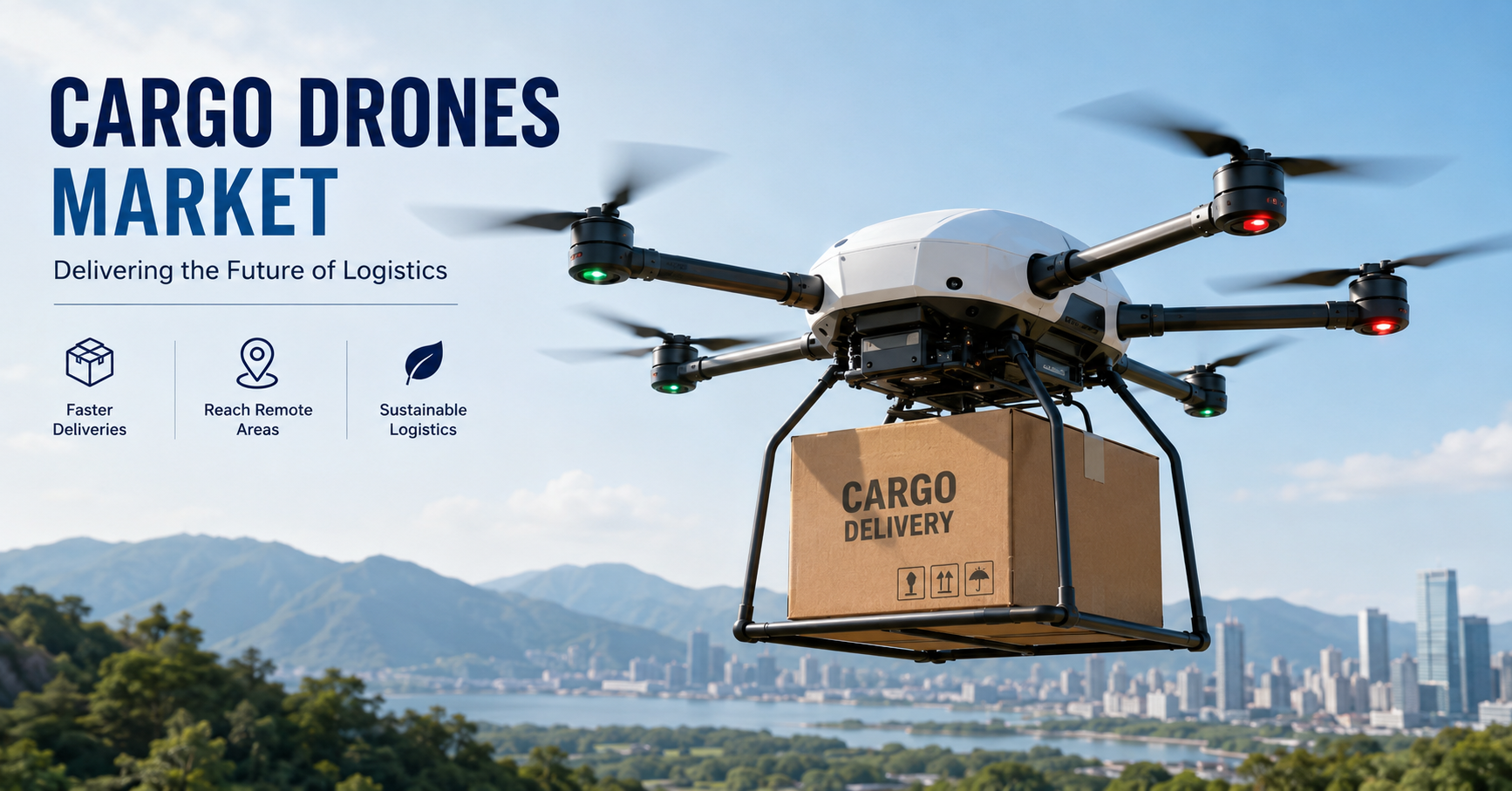
NEW YORK, NY, UNITED STATES, June 19, 2026 /EINPresswire.com/ — The global Cargo Drones Market is witnessing a transformative phase as logistics providers, healthcare organizations, e-commerce companies, and government agencies increasingly adopt unmanned aerial systems for cargo transportation. Cargo drones are emerging as a viable solution for overcoming transportation bottlenecks, reducing delivery timelines, improving accessibility to remote locations, and enhancing supply chain efficiency.
According to industry estimates, the Cargo Drones Market was valued at USD 2.10 Billion in 2025 and is projected to reach USD 43.18 Billion by 2035, registering a remarkable CAGR of 36.95% during the forecast period from 2026 to 2035.
The rapid evolution of autonomous flight technologies, advancements in battery systems, integration of artificial intelligence (AI), and supportive regulatory developments are accelerating market expansion globally. Cargo drones are increasingly being deployed across commercial logistics, healthcare deliveries, agricultural supply transportation, and infrastructure-related applications, creating significant opportunities for manufacturers and service providers.
Key Market Drivers:
1. Growing Demand for Last-Mile Delivery Optimization
The continuous expansion of e-commerce activities has intensified the need for faster and more cost-effective delivery networks. Cargo drones offer a practical solution for last-mile logistics by bypassing road congestion and reducing transportation time. Their ability to perform direct point-to-point deliveries makes them highly attractive for logistics operators seeking operational efficiency.
2. Rising Adoption in Healthcare Logistics
Healthcare institutions are increasingly utilizing cargo drones to transport medicines, vaccines, blood samples, and emergency medical supplies to remote and underserved locations. The ability to deliver critical healthcare products rapidly has strengthened the role of cargo drones in emergency response and rural healthcare infrastructure.
3. Technological Advancements in Autonomous Flight Systems
Continuous improvements in autonomous navigation, obstacle avoidance technologies, AI-powered route optimization, and communication systems are enhancing the operational capabilities of cargo drones. These advancements are enabling safer and more reliable commercial deployments across multiple industries.
4. Increasing Focus on Sustainable Transportation
Governments and corporations worldwide are seeking environmentally friendly transportation alternatives. Electric cargo drones support carbon reduction objectives by lowering dependence on conventional fuel-powered transportation systems, making them an attractive component of sustainable logistics strategies.
Market Opportunities:
1. Expansion into Remote and Rural Delivery Networks
Large geographical regions continue to face transportation challenges due to inadequate infrastructure. Cargo drones provide efficient access to rural communities, mountainous regions, islands, and disaster-affected zones, creating substantial market opportunities for drone operators and logistics providers.
2. Growth of Autonomous Logistics Ecosystems
The development of integrated drone traffic management systems, smart warehouses, and autonomous supply chain networks is expected to unlock new revenue streams for cargo drone manufacturers and service providers.
3. Emerging Defense and Government Applications
Government agencies and defense organizations are increasingly evaluating cargo drones for mission-critical logistics, humanitarian operations, and emergency supply transportation. This trend is expected to broaden the commercial potential of advanced heavy-lift cargo drone platforms.
Request Sample PDF Copy: https://www.marketresearchfuture.com/sample_request/11445
Latest Market Trends:
1. Shift Toward Hybrid Drone Platforms
Market participants are focusing on hybrid cargo drones that combine the vertical takeoff and landing capabilities of multirotor systems with the long-range efficiency of fixed-wing aircraft. These platforms offer greater operational flexibility across diverse logistics scenarios.
2. Increasing Automation and AI Integration
Artificial intelligence is becoming a core component of cargo drone operations. AI-enabled systems are improving route planning, predictive maintenance, fleet management, and autonomous decision-making capabilities, enhancing operational efficiency and safety.
3. Development of Heavy-Payload Cargo Drones
Manufacturers are introducing larger cargo drones capable of transporting heavier payloads over extended distances. The trend is expanding the addressable market beyond small parcel delivery into industrial, commercial, and defense logistics applications.
4. Regulatory Advancements Supporting Commercial Deployments
Regulatory agencies across major economies are gradually establishing frameworks for beyond-visual-line-of-sight (BVLOS) operations, enabling broader commercial deployment of cargo drones and facilitating market growth.
Segment Analysis:
1. By Drone Type
Multirotor Drones – Multirotor drones represent a significant portion of the market due to their operational flexibility, vertical takeoff and landing capabilities, and suitability for urban logistics applications. Their ability to navigate congested environments makes them ideal for short-distance cargo transportation.
Fixed-Wing Drones – Fixed-wing cargo drones are gaining adoption for long-range transportation missions. Their superior endurance and energy efficiency support logistics operations covering larger geographical areas.
Hybrid Drones – Hybrid drones are increasingly attracting investments because they combine the advantages of multirotor and fixed-wing technologies. These platforms are expected to witness substantial growth during the forecast period.
2. By Load Capacity
Less than 5 kg – This category serves lightweight package deliveries, including healthcare products, small consumer goods, and emergency supplies.
5 kg to 20 kg – The segment supports a wide range of commercial deliveries and is increasingly utilized in retail logistics and medical transportation.
20 kg to 50 kg – Growing demand for industrial transportation and specialized logistics solutions is contributing to segment expansion.
Above 50 kg – Heavy-lift cargo drones are emerging as a promising category, particularly for industrial, defense, and infrastructure-related applications.
3. By Application
E-commerce Delivery – The e-commerce segment remains a major application area due to increasing consumer demand for rapid deliveries and enhanced logistics efficiency.
Medical Supplies Delivery – Healthcare organizations continue to deploy cargo drones for the transportation of medicines, blood products, laboratory samples, and emergency healthcare supplies.
Agricultural Delivery – Agricultural operators are increasingly utilizing cargo drones for transporting seeds, fertilizers, and crop protection products to farming locations.
Infrastructure Inspection – Cargo drones are supporting infrastructure projects through equipment transportation and inspection-related logistics operations.
4. By Technology
Autonomous Drones – Autonomous drones are witnessing increasing demand due to advances in AI, machine learning, and navigation systems that minimize human intervention.
Remote Controlled Drones – Remote-controlled cargo drones continue to serve specialized applications where direct operator supervision remains essential.
Semi-Autonomous Drones – Semi-autonomous systems offer a balance between automation and operational control, supporting broader commercial adoption.
5. By End User
Healthcare Sector – Healthcare remains a strategic end-user segment, driven by the growing need for rapid and reliable transportation of medical supplies.
Retail and E-Commerce – Retailers and e-commerce companies are increasingly integrating drone logistics into their delivery ecosystems to improve customer service and operational efficiency.
Agriculture Sector – Agricultural enterprises are adopting cargo drones to enhance supply chain management and improve resource distribution across large farming areas.
Infrastructure and Construction – Construction and infrastructure companies are leveraging cargo drones for transporting equipment, tools, and critical materials to project sites.
Regional Analysis:
North America
North America holds a prominent position in the cargo drones market due to strong technological innovation, favorable regulatory developments, and substantial investments in autonomous logistics solutions. The presence of leading drone manufacturers and logistics companies further supports market expansion.
Europe
Europe continues to experience growing adoption of cargo drone technologies across healthcare, logistics, and industrial applications. Regulatory initiatives supporting drone integration are contributing to regional market development.
Asia-Pacific
Asia-Pacific is expected to emerge as the fastest-growing regional market during the forecast period. Rapid urbanization, increasing e-commerce penetration, government support for drone technologies, and expanding logistics infrastructure are driving growth across countries such as China, India, Japan, and South Korea.
South America
South America is witnessing increasing adoption of cargo drones in remote area logistics, healthcare delivery, and agricultural applications. Ongoing infrastructure development initiatives are expected to support future market growth.
Middle East & Africa
The Middle East & Africa region is gradually embracing cargo drone technology for healthcare distribution, humanitarian assistance, and logistics operations in geographically challenging areas.
Competitive Landscape:
The cargo drones market is characterized by strategic partnerships, technological innovation, product development initiatives, and regulatory engagement activities. Companies are focusing on improving payload capabilities, extending flight ranges, and enhancing autonomous functionalities to strengthen their competitive positioning.
Amazon – Amazon continues to invest heavily in autonomous delivery technologies and drone-based logistics systems aimed at accelerating delivery operations and improving supply chain efficiency.
Zipline – Zipline has established a strong presence in healthcare logistics by delivering medical products to remote communities. The company continues to expand its drone delivery network globally.
Wing – Wing is actively developing advanced drone delivery solutions and expanding commercial operations across multiple markets, focusing on scalable autonomous logistics systems.
UPS – UPS is leveraging drone technologies to enhance logistics efficiency, improve delivery speed, and support specialized transportation services.
DHL – DHL continues to explore cargo drone applications as part of its broader logistics modernization strategy, emphasizing innovation and sustainable delivery solutions.
EHang – EHang is advancing autonomous aerial mobility technologies and expanding its cargo transportation capabilities through innovative drone platforms.
Matternet – Matternet focuses on autonomous drone logistics systems and has established a strong presence in healthcare and commercial delivery applications.
Volansi – Volansi develops long-range cargo drone solutions designed to support commercial, industrial, and defense logistics requirements.
Skycart – Skycart is actively developing cargo drone technologies aimed at improving transportation efficiency across commercial logistics networks.
Recent Developments:
February 2026: ST Engineering introduced the DrN-600 electric cargo drone during the Singapore Airshow. The platform is capable of carrying payloads of up to 100 kilograms and represents a significant advancement in commercial cargo drone development.
August 2025: Grid Aero emerged from stealth mode and unveiled its Lifter-Lite cargo drone platform designed for long-distance cargo transportation, supported by defense-sector funding and strategic investments.
August 2024: China successfully completed test flights of the SA750U unmanned cargo aircraft, demonstrating payload capabilities exceeding three metric tons and highlighting growing investments in large-scale cargo drone technologies.
May 2024: Commercial drone cargo delivery operations expanded in China with the launch of new logistics routes supporting agricultural product transportation between regional markets.
Future Outlook:
The Cargo Drones Market is positioned for exceptional long-term growth as technological advancements, increasing logistics automation, and expanding commercial applications continue to reshape the transportation landscape. Growing acceptance of autonomous delivery systems, supportive regulatory frameworks, and rising investments from both public and private sectors are expected to accelerate market penetration over the next decade.
With increasing adoption across healthcare, retail, agriculture, infrastructure, and industrial sectors, cargo drones are expected to become a critical component of next-generation logistics ecosystems. As organizations pursue faster, more efficient, and environmentally sustainable transportation solutions, the global cargo drones market is likely to witness substantial expansion through 2035.
Browse More Reports:
Drone Defense System Market
https://www.marketresearchfuture.com/reports/drone-defense-system-market-10331
Underwater Drone Market
https://www.marketresearchfuture.com/reports/underwater-drone-market-12257
Micro Drone Market
https://www.marketresearchfuture.com/reports/micro-drone-market-33019
Sagar Kadam
Market Research Future
+1 628-258-0071
sales@marketresearchfuture.com
Visit us on social media:
LinkedIn
Facebook
X
Legal Disclaimer:
EIN Presswire provides this news content “as is” without warranty of any kind. We do not accept any responsibility or liability
for the accuracy, content, images, videos, licenses, completeness, legality, or reliability of the information contained in this
article. If you have any complaints or copyright issues related to this article, kindly contact the author above.

Media gallery