More than half of new FDA approvals are rare disease drugs with 7-figure costs. Most employers have never priced one, and renewal is the only window.
CO, UNITED STATES, August 18, 2026 /EINPresswire.com/ — Limitless Consulting released an analysis of orphan drug costs on self-funded employer health plans. The firm found that 10 rare disease medications commonly seen on employer claims files each account for $468,000 to $1.44 million a year in cost the plan does not have to absorb.
Palynziq carried the largest figure at $1.44M a year, followed by Miplyffa at $1.40M, Strensiq at $1.15M and Lumizyme at $948K. Takhzyro carried the smallest at $468K.
Limitless Consulting evaluates high-cost medications across 9 optimized sourcing channels. In the case of orphan drugs, the firm’s Foundation program is a domestic-only solution using supplemental coverage to cover the cost of the medication. Every medication is dispensed inside the United States and nothing is imported.
Lower drug costs without replacing the PBM or the plan. The question employers and benefits consultants bring to Limitless is how to lower the cost of high-cost and specialty medications without replacing the PBM, the carrier or the plan. The Foundation program was built for that case. The medication is not bought at a discount or brought in from another market, and the member’s therapy does not change. The employer keeps its PBM, its carrier and its network, and the program runs alongside them. Limitless administers a coverage route that moves the medication off the employer’s plan, with enrollment and member support handled by the program instead of the employer’s staff. The employer plan pays $0 for the drug and the member pays $0. Eligibility is based on drug classification.
Rare disease drugs now lead new approvals. An orphan drug treats a condition affecting fewer than 200,000 Americans. Congress created the designation in the Orphan Drug Act of 1983 to make treatments for populations that small worth developing. The FDA approved 50 novel drugs in 2024, and 26 were for rare diseases. In 2025, 25 of 46 carried orphan designation. Optum reports a median launch price of $218,872 a year for orphan drugs against $12,798 for other drugs, and gene therapies can run $1M to $3M.
A small number of members carry the cost. Mercer reports employers projecting a 6.7% cost increase for 2026, the highest in 15 years, with costs passing $18,500 per employee. Behind that average the spending is concentrated. Pharmaceutical Strategies Group reviewed 204 million medical claims and found 5.5% of members used at least 1 specialty drug, with utilization driving 10.6 of the 10.8 percentage points of specialty trend. Aegis Risk found 49% of self-funded plans had a claimant exceed $1,000,000 in the prior 2 policy years.
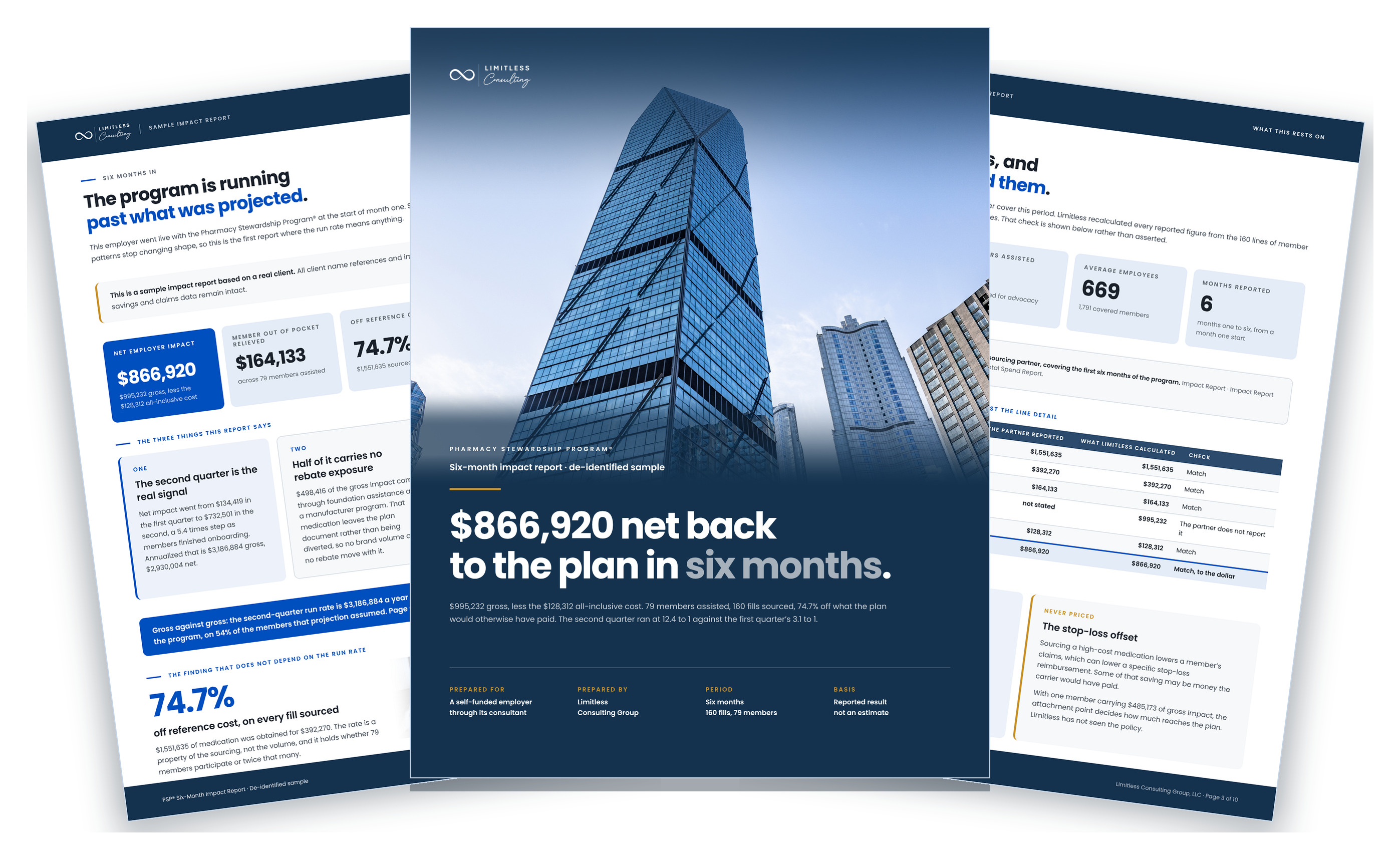
Limitless sees the same concentration in its own reporting. A de-identified six-month impact report from a plan with 669 average employees shows 79 members assisted across 160 fills and 36 medications, $995,232 in gross employer impact and $866,920 net of the $128,312 program cost. One member on an orphan-class therapy accounted for 48.7% of the total. The figures exclude rebate loss and stop-loss offset because neither was supplied for that plan.
“No responsible employer is going to refuse to cover one of these drugs, and they shouldn’t,” said Louis Gallucci, CEO of Limitless Consulting Group. “There is a member on the other side of that claim who needs it, and about half of the people living with a rare disease in this country are children. Coverage was never the question. The question is what the plan pays to get the drug, and in most plans nobody ever made that decision. It came in with a contract that predates the current benefits team, and it renews every year.”
A second effect stays out of the firm’s estimates. These members are usually a plan’s largest claimants, so the catastrophic exposure leaves the plan with the medication. Limitless does not claim it until the stop-loss carrier confirms it.
The renewal window. The Foundation route requires an orphan drug exclusion in the plan document. Amendments are difficult to get mid-year and routine at renewal, which is why the firm released the analysis now. “A 6.7% trend number invites a 6.7% response,” said Mike McLain, Co-Founder and President. “A good team moves a copay tier and tightens the network, and none of it touches where the money went. The spend sits with a few members on a few medications, and orphan drugs are the sharpest version of that.”
Legal scrutiny of drug purchasing is also advancing. Employees of large self-funded employers have brought a series of ERISA suits over what their plans paid for prescription drugs, and this year one moved past the pleading stage on claims involving excessive payments to a pharmacy benefit manager. Others have been dismissed and are on appeal, and none has been decided on the merits.
“ERISA does not require an employer to buy a drug from the lowest-cost source,” McLain said. “But fiduciary prudence has always demanded a defensible process. When one medication can carry a difference approaching $1.5 million a year, the question for a plan sponsor is simple. Did you ever look at what else you could have paid, weighed alternative options, and documented the decision?”
How to claim a complimentary renewal analysis. Limitless is running the same analysis on any self-funded plan’s own claims at no cost through the 2027 renewal season. An employer or consultant sends a claims file or a Top 25 drug list, and a written analysis of every orphan and high-cost medication comes back in 1 to 3 business days. There is no fee and no obligation, and where a current arrangement is already competitive, the firm says so in writing.
Files can be submitted at LimitlessRxSolutions.com/get-started. Add Renewal2027 in the comments to claim the free analysis. The de-identified impact report is available on request.
“If there is nothing there, we will tell you there is nothing there,” Gallucci said. “That answer is worth having in writing before you sign a renewal. What I would not do is sign one without asking the question, because the plan document closes behind you and the number sits there for another year.”
Claire Morgan
Limitless Consulting Group
claire.morgan@limitlessrxsolutions.com
Visit us on social media:
LinkedIn
Legal Disclaimer:
EIN Presswire provides this news content “as is” without warranty of any kind. We do not accept any responsibility or liability
for the accuracy, content, images, videos, licenses, completeness, legality, or reliability of the information contained in this
article. If you have any complaints or copyright issues related to this article, kindly contact the author above.

Media gallery